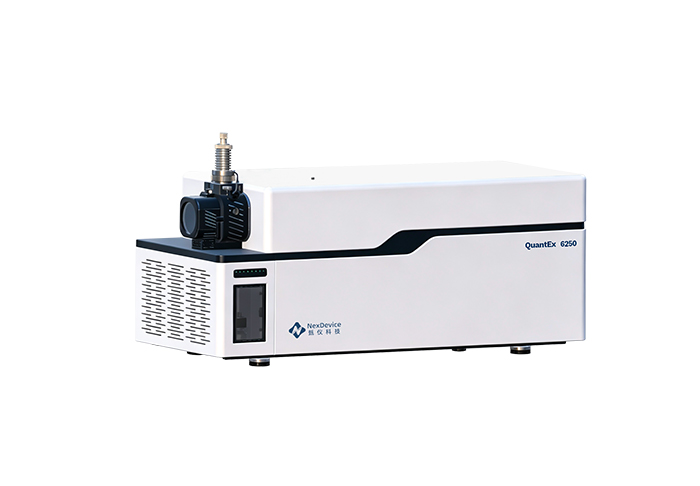

AccuraSys QuantEX 6250 LC-MS/MS is the preferred choice for pesticide residue analysis.
The 33 target pesticides and metabolites encompass various chemical classes and exhibit a wide range of physicochemical properties. Some are highly polar and water-soluble, while others are highly lipophilic. Certain herbicides are prone to adsorption by solid-phase cleanup materials, whereas some metabolites are significantly more polar than their parent pesticides. Simultaneous multi-component analysis may lead to chromatographic co-elution, ion suppression/enhancement, and shifts in quantitative results. In addition, plant-based food matrices are complex: tea and spices are rich in pigments and polyphenols, while cereals and oilseeds contain high levels of lipids, resulting in significant matrix interference.
Liquid chromatography–tandem mass spectrometry using a triple quadrupole mass spectrometer (LC–MS/MS), with its high selectivity and sensitivity, is therefore the preferred confirmatory analytical technique for multi-residue pesticide determination.
Test Results
Calibration Curves and Limits of Quantification
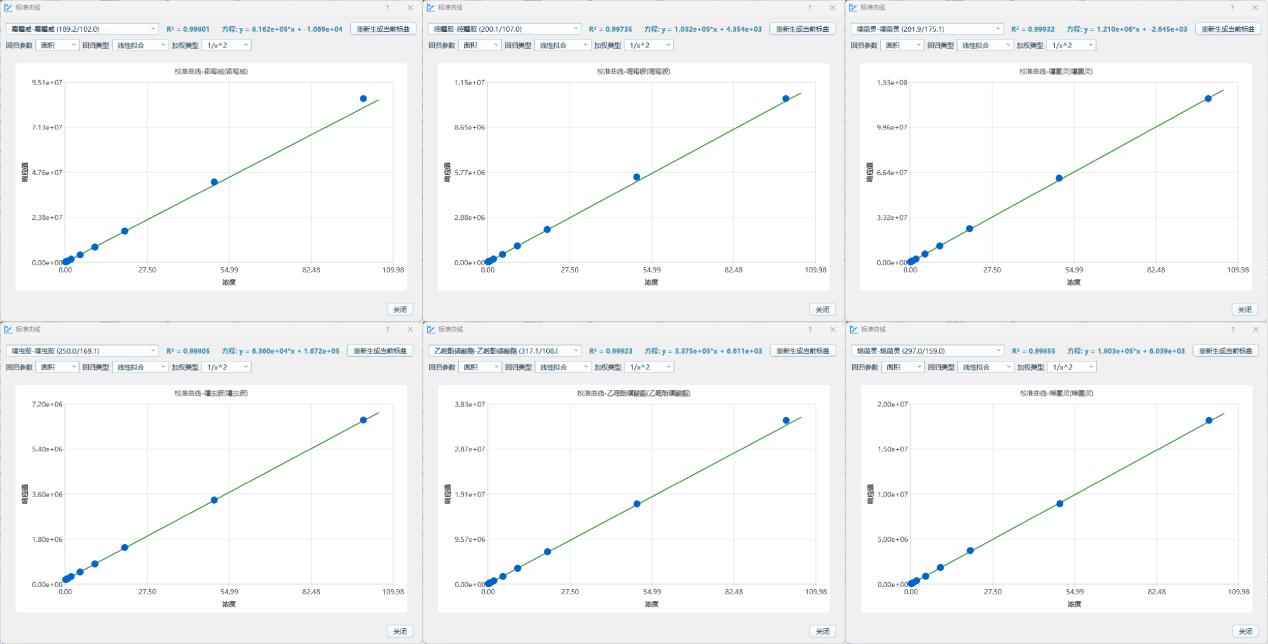
The figure shows the calibration curves for selected compounds. The correlation coefficients (r) for all compounds were greater than 0.99, demonstrating excellent linearity and ensuring the accuracy and reliability of the analytical results.
Conclusion
In this study, a simultaneous trace-level analytical method was successfully developed for the determination of 33 pesticides and their metabolites across multiple chemical classes using the AccuraSys QuantEX 6250 triple quadrupole mass spectrometry platform, in accordance with GB 23200.121-2021 (2026 revision). By optimizing a multi-component-compatible chromatographic gradient, segment-specific multiple reaction monitoring (MRM) mass spectrometric parameters, and a QuEChERS extraction–dispersive solid-phase extraction (d-SPE) cleanup procedure, combined with comprehensive matrix-effect correction and full-process quality control strategies, efficient separation and accurate quantification were achieved for 33 pesticides and their metabolites, including organophosphorus compounds, triazines, sulfonylureas, and oxazoles.
The developed method exhibited excellent linearity and high sensitivity, with accuracy meeting the requirements of the national standard for trace-level multi-component analysis. The method also demonstrated strong resistance to matrix interference and excellent system stability. In addition, the procedure is simple to operate, provides comprehensive analyte coverage, and has broad applicability. It can be widely applied to the simultaneous monitoring of residues of 33 pesticides and their metabolites in plant-derived foods, including vegetables, fruits, edible fungi, cereals, oilseeds, nuts, tea, spices, and vegetable oils. The method provides stable and reliable technical support for food safety risk monitoring and routine laboratory testing.